
The West African Examination Council, WAEC, has set the 2026 WAEC Economics Questions And Answers paper for 17th June 2026. Candidates are now preparing to perform well in the upcoming examination through the help of reliable resources, such as:
- WAEC Economics 2026 Questions and Answers
- WAEC Economics Expo 2026
- WAEC Economics Question 2026
- WAEC Economics Answer 2026
If you are one of these candidates, this article has provided the step-by-step guide on how to prepare effectively for access to verified solutions and to succeed in your 2026 WAEC Economics exam.
WAEC ECONOMICS 2026 ESSAY ANSWERS
NUMBER TWO
2(a)
Pie Chart.
2(b)
Excise duty is a tax charged by a government on specific goods produced, sold, or used within a country.
2(c)(i)
From the chart:
x = 360° − (85° + 80° + 74° + 49°)
x = 360° − 288°
x = 72°
Personal Income Tax = $800 million
Total Revenue = (360 × $800 million) ÷ 72
= $4 billion
∴ Total Revenue = $4 Billion
2(c)(ii)
Direct Taxes = Company Tax + Personal Income Tax
= (74° + 72°) / 360° × $4 billion
= 146/360 × $4 billion
= $1.622 billion
∴ Total Direct Tax = $1.622 Billion
2(d)
Indirect Taxes = Sales Tax + Import Duty + Excise Duty
= (49° + 80° + 85°) / 360° × 100
= 214/360 × 100
= 59.44%
∴ Percentage of Total Revenue Collected from Indirect Tax = 59.44%
2(e)
(PICK ANY TWO)
- Indirect taxes are difficult to evade and therefore provide a reliable source of government revenue.
- They can be used to influence consumers’ spending habits and discourage the consumption of harmful goods.
- They are convenient to collect since they are paid when goods and services are purchased.
- They cover a wide range of consumers, thereby generating substantial revenue for the government.
- They can help protect local industries by making imported goods more expensive.
NUMBER THREE
3(a) Explain why a scale of preference is important to an individual.
(i) A scale of preference helps an individual to arrange his wants in order of importance so that the most urgent needs are satisfied first.
(ii) It enables an individual to make wise and rational choices when available resources are limited.
(iii) It helps in the efficient allocation and utilization of scarce resources, thereby reducing waste.
(iv) It assists an individual in preparing a budget and controlling expenditure according to priorities.
(v) It helps an individual to achieve maximum satisfaction from the resources available to him.
3(b) Discuss how the knowledge of the basic concepts of Economics can help a producer.
(i) It helps the producer to allocate scarce resources efficiently.
(ii) It enables the producer to determine the most profitable level of production.
(iii) It assists in estimating and forecasting consumer demand.
(iv) It helps in fixing appropriate prices for goods and services.
(v) It enables the producer to minimize production costs and maximize profit.
(vi) It helps in making decisions regarding the combination of factors of production.
(vii) It assists in understanding market conditions and competition.
(viii) It helps the producer to plan for expansion and investment.
(ix) It enables the producer to assess risks and uncertainties in business.
(x) It helps in evaluating government policies and their effects on production.
3(c) State any four factors that can help a producer to increase the supply of a commodity.
(PICK ANY FOUR)
- Improvement in technology.
- Reduction in the cost of production.
- Availability of adequate raw materials.
- Increase in the number of producers.
- Government subsidies to producers.
- Availability of credit facilities.
- Favourable government policies.
- Improvement in transportation and communication facilities.
NUMBER FIVE
5(a) Distinguish between a firm and an industry.
A firm is a business unit that produces goods or services. It may be owned by one person or a group of people. An industry, on the other hand, is made up of all the firms producing the same or similar products. For example, a bakery is a firm, while all bakeries together form the baking industry.
OR
A firm refers to a single business organization engaged in production or distribution activities with the aim of making profit. An industry consists of a group of firms involved in the production of similar goods or services. For instance, a textile company is a firm, whereas all textile companies together constitute the textile industry.
5(b) Match the following characteristics to these business entities.
- (i) Public Limited Liability Company
- (ii) Sole Proprietorship
- (iii) Sole Proprietorship
- (iv) Public Limited Liability Company
- (v) Partnership
- (vi) Public Limited Liability Company
- (vii) Partnership
- (viii) Public Limited Liability Company
5(c) Equilibrium Position of a Profit-Maximizing Firm in Monopolistic Competition Making a Loss
Use the diagram below:
https://i.ibb.co/Vfx2WVz/Chat-GPT-Image-Jun-17-2026-08-33-12-PM.png
NUMBER SIX
6(a) Define Industrialization.
Industrialization is the process by which a country develops its industries through the establishment and expansion of manufacturing and other industrial activities, leading to increased production of goods and services.
6(b) Distinguish between Location of Industry and Localization of Industry.
Location of industry refers to the siting or establishment of a particular industry in a specific place based on factors such as availability of raw materials, labour, market, power supply, and transportation.
WHILE
Localization of industry refers to the concentration of many firms producing the same or similar products in a particular area or region, resulting in the growth of an industrial cluster.
6(c)(i) A Sawmill
Location: Near a forest or timber-producing area.
Reasons:
- Easy access to logs and timber.
- Reduces transportation cost of bulky raw materials.
- Minimizes wastage and damage during transportation.
- Ensures continuous supply of raw materials.
6(c)(ii) A Ceramic Tile Producing Factory
Location: Near deposits of clay and other ceramic raw materials.
Reasons:
- Clay is the major raw material.
- Transportation cost is reduced.
- Constant supply of raw materials is guaranteed.
- Production costs are lowered.
6(c)(iii) An Egg-Producing Poultry Farm
Location: Close to a large urban market.
Reasons:
- Eggs are highly perishable.
- Transportation costs are reduced.
- A large market ensures steady demand.
- Fresh eggs reach consumers quickly, reducing spoilage.
NUMBER SEVEN
7(a) Explain the relationship between economic growth and economic development in Country X.
Economic growth refers to the increase in the value of goods and services produced in an economy, usually measured by GDP. In Country X, GDP increased from $50 billion to over $100 billion, showing that economic growth occurred.
WHILE
Economic development involves improvements in welfare and quality of life through better income, education, healthcare, and employment opportunities. Although Country X experienced economic growth, economic development was limited because poverty remained high, unemployment was high, and living standards did not improve significantly.
7(b) Explain how economic growth relates to the standard of living in Country X.
Economic growth can improve the standard of living by increasing national income, creating employment opportunities, and providing more resources for social services such as education and healthcare.
However, in Country X, despite the growth in GDP, the standard of living remained low because per capita income was only $1,850, poverty affected 37% of the population, and unemployment stood at 23%. This suggests that the benefits of economic growth were not widely distributed among the citizens.
7(c) State any four possible reasons the economic plan was not successfully implemented.
(PICK ANY FOUR)
- Inadequate funding.
- Corruption and embezzlement.
- Poor planning.
- Lack of skilled manpower.
- Political instability.
- Poor infrastructure.
- Weak monitoring and supervision.
- Rapid population growth.
NUMBER EIGHT
8(a)(i) Import Quotas
Import quotas are quantitative restrictions imposed by the government on the amount or value of specific goods that may be imported into a country within a given period.
8(a)(ii) Embargo
An embargo is a government policy that completely prohibits the importation or exportation of certain goods or all goods to and from a particular country.
8(a)(iii) Import Licences
Import licences are official documents or permits issued by the government authorizing individuals or firms to import specified goods into a country.
8(a)(iv) Foreign Exchange Control
Foreign exchange control refers to measures introduced by the government or central bank to regulate the purchase, sale, and use of foreign currencies.
8(b) Outline three ways in which exports can be promoted in a country.
(PICK ANY FOUR)
- Provision of export subsidies to exporters.
- Granting tax reliefs and incentives to exporting firms.
- Improvement of transportation and communication facilities.
- Provision of adequate credit and loans to exporters.
- Establishment of export promotion agencies.
- Improvement in the quality and standard of export products.
- Participation in international trade fairs and exhibitions.
- Reduction of bureaucratic procedures involved in exportation.
How to Get 2026 WAEC Economics Questions and Answers
At MasterWAEC, we are committed to the success of candidates. Our platform provides accurate and verified solutions tailored to help you boost your confidence and increase your chances of making high grades like B2, B3, and C’s.
Available Subscription Options for WAEC Answers
We have made it easy for you to access WAEC GCE Economics answers by providing two convenient subscription methods:
1. Online PIN (₦1000)
Get access PIN to view verified answers online on our answer page. Answers will be delivered 4 hours before the exam starts.
2. WhatsApp Delivery (₦1000)
Get the answers directly on WhatsApp after confirmation of your subscription. Get the answers delivered straight to your phone.
How to Subscribe for WAEC Answers
Here is the simple procedure one should follow in order to secure his/her access:
- Pay The Subscription Fee:
Use any preferred payment method. For account details, chat with us on WhatsApp at 08151297236
- Provide the Required Details:
Send the following information to 08151297236 on WhatsApp:
- Evidence of payment (e.g., transfer receipt or sender’s name).
- The subject you are subscribing for (e.g., WAEC Economics).
- Your phone number.
Once your payment is confirmed, the answers will be delivered based on your preferred method.
Why Choose masterWAEC?
Here are the reasons why thousands of candidates trust masterWAEC.com for their exam preparation:
1. Verified Answers: We deliver accurate solutions designed to guarantee success.
2. Timely Delivery: Answers will be delivered at least 4 hours before your exam time or by midnight.
3. Flexible Subscription Methods: Use whatever method that works for you, whether it is online PIN or WhatsApp delivery.
4. Dedicated Support: Our support team is always ready to attend to any issues or questions you might have.
Joipreparatio Miracle Center
Join our private WhatsApp group, where we will be providing:
- Verified answers
- Timely updates
- Pro tips to aid your success
Conclusion
The WAEC Economics 2026 exam is your opportunity to show the world what you are made of and to come out with fantastic grades. With masterWAEC.com trusted resources, you can prepare with confidence and secure the results you desire.
RELATED POST:
WAEC Economics Syllabus 2026 Free Download
2026 WAEC Government Questions And Answers
WAEC Financial Accounting 2026 Questions and Answers
2026 WAEC Biology Questions And Answers
2026 WAEC Mathematics Questions And Answers
WAEC English Language 2026 Questions and Answers
2026 WAEC Commerce Questions And Answers (WASSCE)
WASSCE Economics Paste Questions And Answers
Are you preparing for the upcoming WAEC Economics exam and found your self here searching for the Nigeria WASSCE 2025 economics past questions and answers? If yes, search no more as we have shared it with you in this page for free. Candidates are now preparing to perform well in the upcoming examination through the help of reliable resources such as masterwaec.com
WAEC Economics Exam Format
WAEC Economics 2025 paper is divided into two parts:
PAPER 1: This paper consist of 50 objectives questions which candidate will answers in 1 hour for 50 marks
PAPER 2: the paper 2 consist of 8 essay questions which is divided in to two sections.
Candidates are required to answers 4 questions in all, one question from section A and any other 3 from section B.
The economics essay paper will last for 2 hours and also carried 80 marks.
2025 WAEC Economics Past Questions And Answers
Essay Questions Section A
Answer one question only from this section.
Question 1:
Figure 1 below shows the output, cost, and revenue position of a business producing tissue paper. Study the diagram and answer the questions that follow.

(a) Determine the firm’s equilibrium price and output.
(b) Which of the curves represents the market’s demand curve?
(c) In what market is the firm operating? Give a reason for your answer.
(d) At the profit maximizing level of output, identify the area that represents:
(i) Total revenue
(ii) Total cost
(iii) Profit or loss
(e) What is the implication of the profit or loss earned on the market in 1(d)(iii)?

Question 2:
The terms of trade position for Country X for the years 2020 and 2021 are stated in table 1 below. Study the table and answer the questions that follow.
Table 1: Price Index of Exports and Imports
| YEAR | PRICE INDEX OF EXPORTS | PRICE INDEX OF IMPORTS |
| :— | :— | :— |
| 2020 | 180 | 180 |
| 2021 | 160 | 200 |
(a) Calculate the terms of trade for Country X in 2020 and 2021.
(b) In what year(s) is the terms of trade:
(i) favorable?
(ii) unfavorable?
Give a reason for your answer in each case.
(c) State any two likely reasons for the terms of trade position identified in 2(b)(ii).
(d) If the balance of trade in 2022 is $4,602,500 and the current account balance is -$8,12,500, determine the country’s balance of invisible trade. Explain your answer.
ANSWER

Section B
Answer three questions only from this section.
Question 3:
(a) Distinguish between complementary goods and substitute goods.
(b) Using diagrams, explain how a decrease in the supply of meat, other things being equal, will affect the equilibrium price and quantity of:
(i) meat.
(ii) fish.
Question 4:
(a) Define minimum price control.
(b) Identify any three reasons governments should introduce minimum prices for agricultural produce.
(c) Outline any three disadvantages of imposing minimum price control on agricultural produce.
ANSWER
(4a)
Minimum price control is a government policy that sets the lowest allowable price for a good or service, usually above the market equilibrium price. It is intended to ensure producers, such as farmers, receive a fair income and are protected from excessively low prices.
(4b)
(PICK THREE ONLY)
(i) To protect farmers’ income: It guarantees that farmers receive a minimum amount for their produce, helping them sustain their livelihoods.
(ii) To encourage agricultural production: By ensuring a stable income, farmers are more likely to invest in and continue farming activities.
(iii) To ensure food security: A stable agricultural sector helps maintain a consistent food supply for the population.
(iv) To stabilize market prices: It helps prevent extreme fluctuations in agricultural prices that could harm producers and consumers.
(v) To reduce rural poverty: Minimum prices provide economic support to small-scale and vulnerable farmers, improving their standard of living.
(vi) To discourage rural-urban migration: When farming is profitable, people are less likely to leave rural areas to search for jobs in urban centers.
(vii) To protect strategic agricultural sectors: It helps preserve essential crops and farming industries critical to national interests and food independence.
(4c)
(PICK THREE ONLY)
(i) Surpluses may occur: When the minimum price is set above the market equilibrium, it can lead to overproduction, resulting in excess supply.
(ii) Wastage of resources: Unsold surplus produce may go to waste if not properly stored or purchased by the government.
(iii) Increased government expenditure: The government may need to buy up the surplus to maintain the price floor, which can strain public finances.
(iv) Storage and preservation challenges: Managing large quantities of surplus agricultural products requires significant storage facilities and logistics.
(v) Market distortion: Artificial pricing interferes with the free market, leading to inefficiencies in production and resource allocation.
(vi) Encourages inefficiency: Farmers may continue producing low-quality or unnecessary crops since they are guaranteed a minimum price, reducing motivation for innovation or improvement.
(vii) Higher prices for consumers: Consumers may have to pay more for agricultural products than they would under free market conditions, reducing affordability.
Question 5:
(a) Define production costs.
(b) Distinguish between implicit cost and explicit cost.
(c) Using appropriate examples, distinguish between fixed input and variable input.
(d) State any four types of short-run costs.
ANSWER
(5a)
Production costs refer to the total expenses a firm incurs in the process of producing goods or services, including both fixed and variable costs such as wages, raw materials, machinery, rent, and utilities that are essential for the production process.
(5b)
Real cost refers to the overall effort, sacrifice, and opportunity cost involved in the production of goods or services, including non-monetary factors such as time, energy, and alternative uses of resources, WHILE explicit cost refers to the actual out-of-pocket monetary expenses a firm pays for inputs like wages, rent, and raw materials that are recorded in the firm’s financial statements.
(5c)
A fixed input is an input whose quantity remains unchanged regardless of the level of output in the short run, while a variable input is an input whose quantity changes with the level of output. For example, the size of a factory is a fixed input because it cannot be changed immediately with production changes, while labor used in packaging is a variable input because the number of workers can be increased or decreased based on production needs.
(5d)
(PICK FOUR ONLY)
(i) Total Fixed Cost (TFC): It refers to the cost that does not change with the level of output in the short run: even if production is zero, the firm still incurs these costs such as rent, interest on capital, and salaries of permanent staff.
(ii) Total Variable Cost (TVC): These are costs that change directly with the level of production: they include expenses like raw materials, power usage, and wages for temporary labor which increase as output increases.
(iii) Total Cost (TC): This represents the overall cost of production in the short run: it includes both fixed and variable costs incurred by a firm at a given level of output.
(iv) Average Fixed Cost (AFC): It indicates the fixed cost per unit of output produced: as production increases, this cost decreases because the fixed cost is spread over more units.
(v) Average Variable Cost (AVC): This is the variable cost per unit of output: it generally decreases initially with rising output due to better resource utilization, but later increases due to diminishing returns.
(vi) Average Total Cost (ATC): It shows the total cost per unit of output: it reflects how efficiently both fixed and variable costs are being used in production.
(vii) Marginal Cost (MC): This is the additional cost incurred when one more unit of output is produced: it helps firms decide the optimal level of production by comparing it with the marginal revenue.
Question 6:
(a) Define monopoly.
(b) State any three factors that give rise to monopolies.
(c) With the aid of a diagram, explain the supernormal profit position of a monopolist.
ANSWER
(6a)
A monopoly is a market structure where a single firm is the exclusive supplier of a product or service without any close substitutes, giving it significant control over prices and market conditions.
(6b)
(PICK THREE ONLY)
(i) Government Regulation and Licensing: Governments often grant exclusive rights to certain firms to produce or sell specific goods or services through patents, copyrights, or special licenses, preventing other firms from entering the market and creating monopoly conditions.
(ii) Control Over Key Resources: A firm that owns or controls essential resources needed for production can limit access to these resources for competitors, allowing the firm to dominate the market and establish a monopoly.
(iii) High Capital Requirements: Some industries require substantial investments in equipment, infrastructure, or research and development, creating a significant financial barrier that prevents new firms from entering the market and allows existing firms to maintain monopolistic control.
(iv) Technological Superiority: A firm with unique technology or production processes can produce at a lower cost or with better quality, giving it a competitive edge that rivals cannot easily match, thus establishing a monopoly.
(v) Network Externalities: In markets where the value of a product or service increases as more people use it, such as social media platforms or payment systems, the largest firm can attract more users, discouraging competition and leading to a monopoly.
(vi) Mergers and Acquisitions: Firms can grow by merging with or acquiring competitors, consolidating their market power and reducing the number of competitors, which can result in a monopoly over time.
(vii) Brand Loyalty and Product Differentiation: Strong brand loyalty and effective differentiation of products through features, advertising, or perceived quality can discourage customers from switching to alternative suppliers, allowing the firm to act as a monopoly in the market.
(6c)
(Draw the diagram)

The monopolist is in equilibrium at point E where MC = MR. At this output level OQ, the price charged is OP, determined by the demand curve (D = AR). The average cost at this output is OC. Since price (OP) is greater than average cost (OC), the firm earns supernormal profit shown by the shaded area PC × OQ.
Question 7:
(a) State any three instruments traded in the money market.
(b) With a relevant example each, explain the condition under which a manufacturer will seek for funds from the:
(i) money market
(ii) capital market.
(c) Explain any three functions of Development banks.
ANSWER
(7a)
(PICK ANY THREE)
(i) Treasury Bills
(ii) Commercial Papers
(iii) Certificates of Deposit
(iv) Repurchase Agreements (Repos)
(v) Bankers’ Acceptances
(vi) Call Money
(7bi)
Money Market: A manufacturer will seek short-term funds from the money market to meet immediate or temporary financial needs such as purchasing raw materials, paying workers’ salaries, or financing daily operations.
Example: A manufacturer facing a cash flow gap before receiving payment from customers may use a treasury bill or commercial paper for short-term financing.
(7bii)
Capital Market: A manufacturer will seek long-term funds from the capital market to finance major projects such as expansion, purchase of machinery, construction of a new factory, or acquisition of fixed assets.
Example: A manufacturer may issue bonds or shares to raise funds for building a new production plant.
(7c)
(PICK ANY THREE)
(i) Provision of long-term loans: Development banks provide long-term financing to sectors like agriculture, industry, and infrastructure.
(ii) Promotion of industrial development: They support the establishment and growth of industries, especially in underdeveloped areas.
(iii) Financing capital projects: They fund major projects such as power plants, roads, and housing, which may not attract private investment.
(iv) Technical and managerial assistance: Development banks offer advisory services and training to entrepreneurs.
(v) Support for small and medium enterprises (SMEs): They provide credit and support to small businesses that struggle to get loans from commercial banks.
Question 8:
(a) What is a regressive system of taxation?
(b) Explain the following principles of taxation:
(i) equity;
(ii) certainty;
(iii) economy.
(c) Outline any three reasons why government imposes tax in a country.
ANSWER
(8a)
A regressive system of taxation is one in which the tax rate decreases as the taxpayer’s income increases. This means that lower-income earners pay a higher percentage of their income in taxes compared to higher-income earners. It places a greater burden on the poor than the rich.
(8bi)
Economy: This principle emphasizes that the cost of collecting a tax should be low relative to the revenue generated. The tax system should not require excessive administrative expenses or burden the taxpayers unnecessarily.
(8bii)
Certainty: This principle means that taxpayers should know exactly how much tax they are expected to pay, when to pay it, and how to pay it. The rules should be clear, consistent, and not arbitrary to avoid confusion and abuse.
(8biii)
Equity: Equity means fairness in taxation. It implies that individuals should pay taxes based on their ability to pay. The rich should contribute more than the poor (vertical equity), and those in similar financial situations should pay similar taxes (horizontal equity).
(8c)
(PICK ANY THREE)
(i) To raise revenue for government expenditure.
(ii) To redistribute income and reduce inequality.
(iii) To control inflation by reducing disposable income.
(iv) To protect local industries (e.g., through import duties).
(v) To discourage the consumption of harmful goods (e.g., tobacco, alcohol).
(vi) To influence investment decisions.
(vii) To fund infrastructure and public services.
2024 WAEC Economics Questions And Answers
Below are the questions and answers for the 2024 WAEC Economics exam:
Question 1
Table 1 below shows the population and Net National Product (NNP) at factor cost for three hypothetical countries in 2021. Use the information in the table to answer the questions that follow.
| Country | Net National Product at Factor Cost ($) | Population |
|---|---|---|
| Q | 140 million | 12 million |
| S | 240 million | 10 million |
| U | 160 million | 10 million |
(a) Calculate the per capital income of country:
(i) Q
(ii) S
(iii) U
(b). From your answers in 1(a), which country has the lowest standard of living?
(c). If in 2022, both the Net National Product (NNP) at factor cost and population of country S declined by 7%:
(i). Calculate the new per capita income.
(ii). What will be the effect on the country’s standard of living?
(d) If the factor income received by the citizens of Country U from abroad is $10 million and the factor income paid to foreigners in the country is $33 million, calculate the Country’s Net Domestic Product (NDP) at factor cost.
Question 2
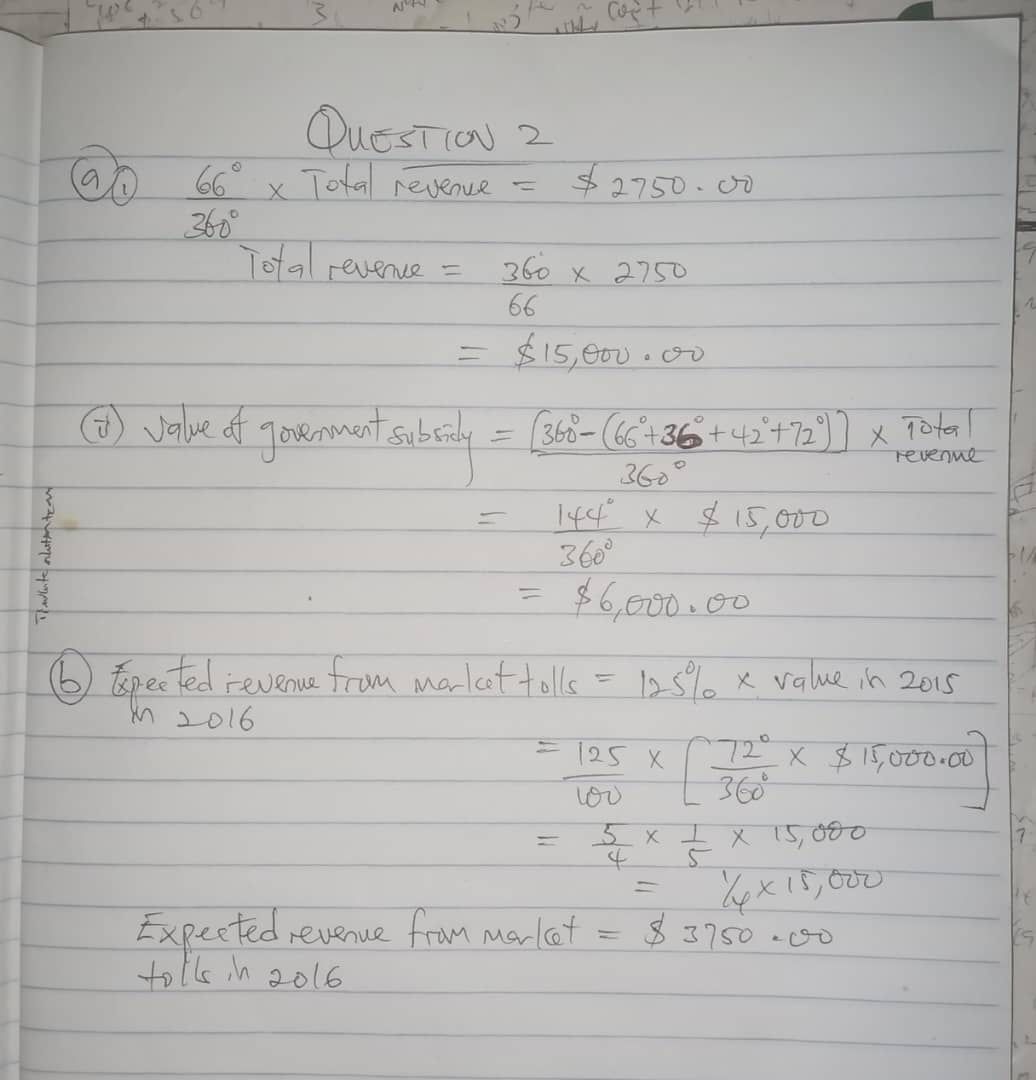
The pie chart in Figure 1 shows the sources of revenue for a local government area in 2015. Study the information and use it to answer the questions below.
(a) If the value of revenue contributed by NGOs was $2,750.00 in 2015:
(i) What was the total revenue for the local government area?
(ii) Calculate the value of Government subsidy.
(b) If the local government area in its 2016 budget projected an increase of 25% for market tolls, calculate the expected revenue from market tolls in 2016.
(c) In 2016, the local government area received $8,500.00 from the Federal Government and it was spent as follows:
- Construction of Schools: 40%
- Wages and Salaries: 30%
- Civic Education: 5%
- Assistance to the Physically Challenged: 10%
- Provision of Pipe-Borne Water: 15%
Question 6: (a) Define the supply of money
supply of money refers to the total amount of money available in an economy at a given time. It includes currency (coins and banknotes) and various types of deposits (such as demand deposits, savings deposits, and time deposits) held by the public in the banking system.
Question 6: (b) Explain how the general price level is influenced by the:
(i). Quantity of money in circulation: The quantity of money in circulation has a direct influence on the general price level. When the money supply increases, there is more money available for spending, leading to increased demand for goods and services. This increased demand, without a corresponding increase in the supply of goods and services, causes prices to rise, resulting in higher inflation
(ii). Velocity of circulation of money: The velocity of money refers to the rate at which money circulates in an economy. If the velocity of money increases, it means that each unit of money is used more frequently to purchase goods and services. This increased velocity of money can lead to higher inflation, as the same amount of money is being used to buy more goods and services.
(iii). Volume of goods and services: The volume of goods and services available in the economy also affects the general price level. If the volume of goods and services increases, while the money supply remains constant, the increased supply of goods and services will put downward pressure on prices, leading to lower inflation or even deflation.
Question 6: (c) Outline any three determinants of the precautionary demand for money
PICK ANY THREE:
- Income level: Individuals with higher incomes tend to hold more precautionary money balances to protect against unexpected expenses or income fluctuations.
- Uncertainty about future income: Individuals who face greater uncertainty about their future income are more likely to hold larger precautionary money balances.
- Risk aversion: Individuals with a higher degree of risk aversion are more likely to hold larger precautionary money balances to protect against unexpected events.
- Access to credit: Individuals with limited access to credit or borrowing options may hold larger precautionary money balances to cover unexpected expenses.
- Financial volatility: Periods of higher financial volatility or economic uncertainty can increase the precautionary demand for money.
- Liquidity preferences: Individuals who prefer to maintain a higher degree of liquidity will hold larger precautionary money balances.
- Life-cycle stage: Individuals in different stages of their life cycle (e.g., retirement) may have different precautionary money balance needs.
- Household composition: The size and composition of a household can affect the precautionary demand for money, as larger households may face more unexpected expenses.
Question 7: (a) Define commercial policy.
Commercial policy refers to the set of government policies and measures that aim to regulate and control the flow of goods, services, and capital between a country and the rest of the world. It includes policies related to trade, investment, and other commercial activities.
Question 7: (b) Identify any three fiscal instruments that can be used to correct a balance of payments deficit.
PICK ANY THREE
- Tariffs: Imposing tariffs or duties on imported goods can make them more expensive, thereby reducing imports and improving the trade balance.
- Quotas: Imposing quantitative restrictions on the amount of certain imported goods can limit the inflow of imports and improve the balance of payments.
- Subsidies: Providing subsidies to domestic producers can make their goods more competitive in the domestic and international markets, boosting exports and reducing imports.
- Exchange rate adjustments: Devaluing the domestic currency can make exports more competitive and imports more expensive, improving the trade balance.
- Import restrictions: Implementing non-tariff barriers, such as licensing requirements or technical standards, can limit the inflow of imports.
- Export promotion: Providing incentives, such as tax credits or subsidies, to domestic exporters can increase the volume of exports and improve the balance of payments.
Question 7: (c) Explain three reasons free trade should be encouraged.
- Increased efficiency and specialization: Free trade allows countries to specialize in the production of goods and services in which they have a comparative advantage, leading to increased efficiency and productivity.
- Wider consumer choice: Free trade expands the variety of goods and services available to consumers, allowing them to choose from a wider range of products.
- Lower prices: Competition from imports can put downward pressure on domestic prices, benefiting consumers.
Question 8: (a) Define renewable natural resources.
Renewable natural resources are resources that can be replenished or regenerated naturally over time and are considered inexhaustible if managed sustainably.
Question 8: (b) With specific examples, explain any three benefits of renewable natural resources to an economy.
- Sustainable Energy Supply: Renewable resources like solar, wind, and hydro energy provide a continuous and sustainable source of power. This helps reduce dependency on non-renewable sources like fossil fuels, ensuring long-term energy security for the economy.
- Job Creation: The development, maintenance, and management of renewable energy resources create employment opportunities in sectors like solar panel installation, wind turbine manufacturing, and sustainable agriculture. This helps reduce unemployment and stimulates local economies.
- Environmental Protection: Renewable resources like wind, solar, and biomass energy produce less pollution compared to fossil fuels. Their use helps reduce air and water pollution, mitigating the effects of climate change and improving public health, which in turn supports a stable economy.
Question 8: (c) Highlight any three importance of land to an economy.
- Source of Raw Materials: Land provides essential raw materials like minerals, timber, agricultural products, and other natural resources that are crucial for industries, manufacturing, and construction. These materials are the foundation for economic activities and production.
- Agricultural Production: Land is the basis for farming and agriculture, which supply food, fiber, and other essential products. Agricultural activities contribute significantly to an economy’s GDP, employment, and food security, making land vital for sustaining populations.
- Employment Generation: The use of land for farming, mining, construction, and industrial activities creates numerous job opportunities for individuals in both rural and urban areas. This helps reduce unemployment and drives economic growth.

Kolade Kayode, known as Mr. KK, I am a Nigerian education blogger and founder of MasterWAEC.com. Passionate about student success, I simplifies WAEC exam preparation with accurate tips and resources to help students excel.